News Post
Dalcroze Education for Youth: Subcommittee Update

Posted September 6, 2023
Current Work
The Dalcroze Education for Youth Subcommittee is comprised of members of the DSA’s Professional Development Committee. We (Adriana Ausch, Jeremy Dittus, Leslie Upchurch, and myself) have been meeting to discuss and organize common goals for Dalcroze students in the 4-7 year old age range. While our meetings began a few years ago with a literature review of other Dalcrozian publications about working with this age group, we quickly found that there could be quite a bit more current resources for Dalcroze teachers of 4-7 year olds.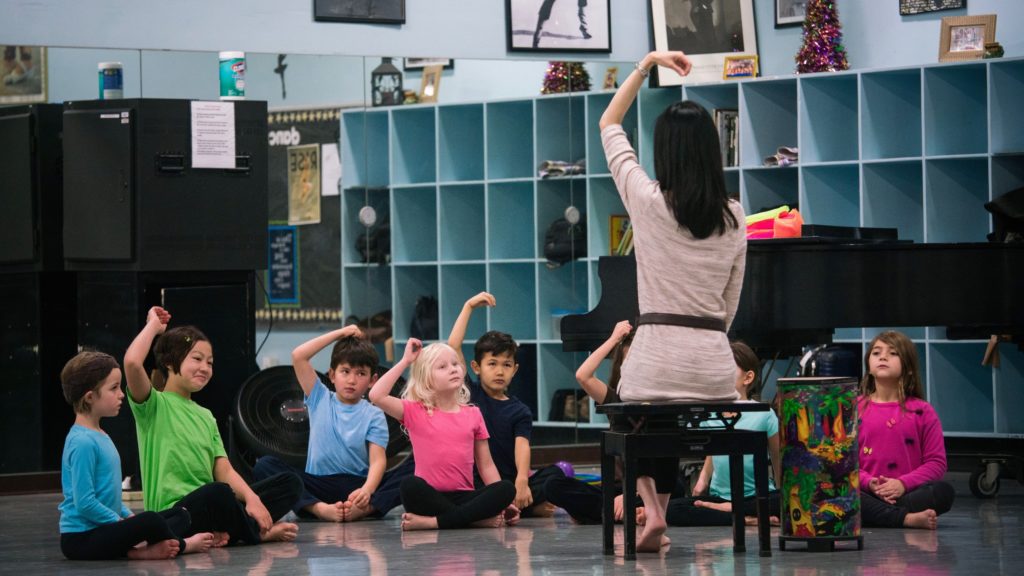
Music/Movement Goals
One aspect we have started to organize is feasible music and movement goals for Dalcroze students aged 4-7. The following is a list of goals based not only on our literature review but also on our personal experiences in working with this age group:- Locomotor Movements (Continuous Movements)
- Beats and/or medium tempi
- Walk, march, step, etc.
- Divisions and/or faster tempi
- Run, tiptoe, trot, jog, prance, les cloche-pieds (step-hop), etc.
- Multiples and/or slow tempi
- Slide, stride, lunge, etc.
- Typical compound meter rhythms
- Beats: swing, sway, skate, etc.
- Divisions: gliding &, running &, tippy-toes, etc.
- Uneven patterns: gallop, chassé, skip, etc.
- Other creative movement possibilities:
- hop, jump, roll, crawl, slither, bounce, swim, float, creep, sneak, leap, glide, sail, fly, etc.
- Patterns (these can be challenging for this age group, but here are some you might try):
- Trotting-March! (e.g.
)
- Running-Running-Running-JUMP! ( e.g.
)
- Turn-a-round-FREEZE! ( e.g.
)
- Trotting-March! (e.g.
- Chassé Chassé ( e.g.
)
- Beats and/or medium tempi
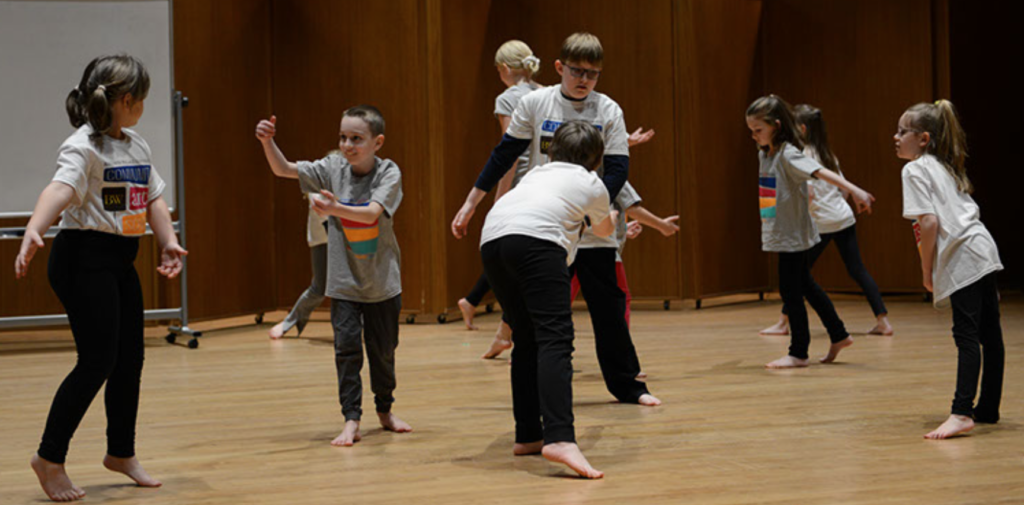
- Movements in Place
- Patsch/tap, clap
- Sway, rock
- Twist, turn, spin, twirl
- Sink, melt, shrink,
- Rise, grow, stretch,
- Wiggle, shake
- Bend/straighten, contract/extend
- Push/pull
- Gestures (with a variety of body parts)
- Body percussion
- Use the body to designate melodic contour
- Use the body to designate rhythms
- Use the body to designate meter
- Etc.
- NB: Some locomotor movements can be done in place and vice-versa
- Expressive Movement/Movement Quality
- Sense of Direction/Intention: forwards, backwards, sideways, etc.
- Imaginative Movement (moving like a character/animal, etc.)
- Dynamics and Expressive Qualities:
- Strong/Gentle
- Rigid/Supple
- Heavy/Light
- Smooth/Jagged
- etc.
- Texture: Thick/thin
- Use of Materials/Props to Facilitate Movement
- Balls, scarves, bean bags
- Percussion: claves, rhythm sticks, drums
- Others: ropes, scarves, elastics, parachutes, floor markers, hoops, ribbon wands etc.


Leave a Reply
You must be logged in to post a comment.