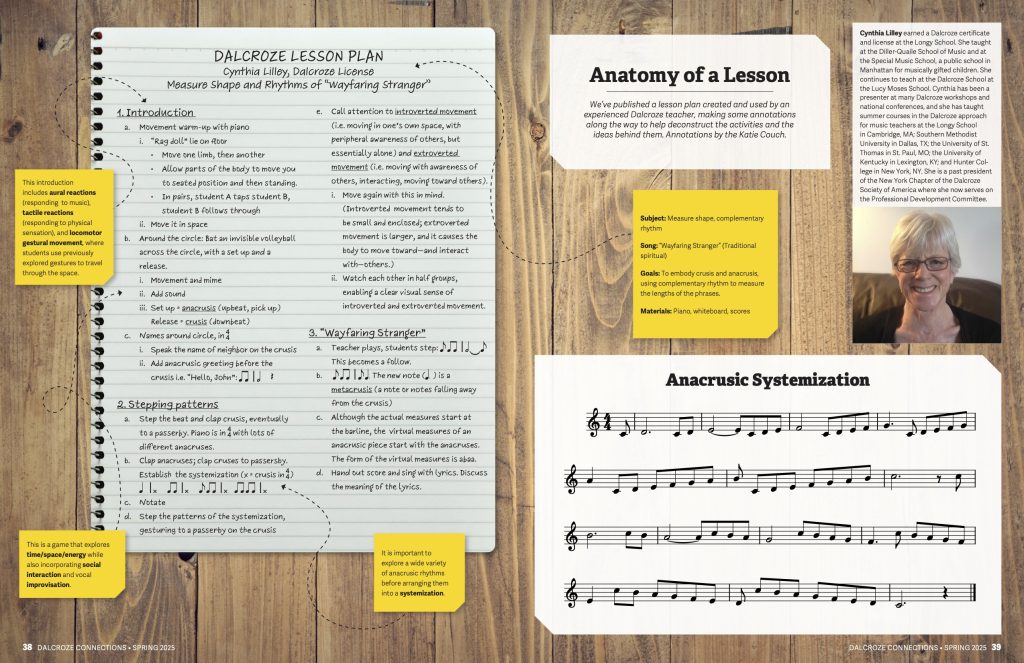
Allow parts of the body to move you to seated position and then standing.
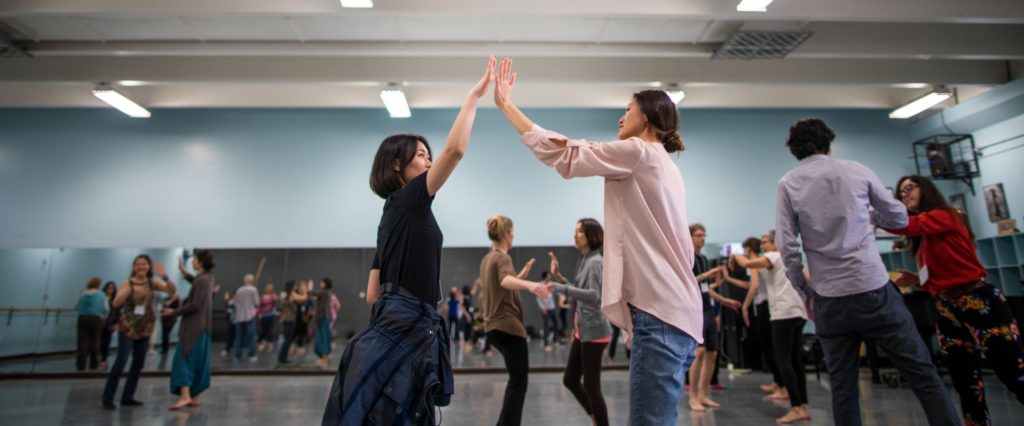
In pairs, student A taps student B, student B follows through
Move it in space
Around the circle: Bat an invisible volleyball across the circle, with a set up and a release.2
Movement and mime
Add sound
Set up = anacrusis (upbeat, pick up) Release = crusis (downbeat)
Names around circle, in {4/4}
Speak the name of neighbor on the crusis
Add anacrusic greeting before the crusis i.e. “Hello, John”: {ee | h}
Stepping patterns
Step the beat and clap crusis, eventually to a passerby. Piano is in {4/4} with lots of different anacruses.
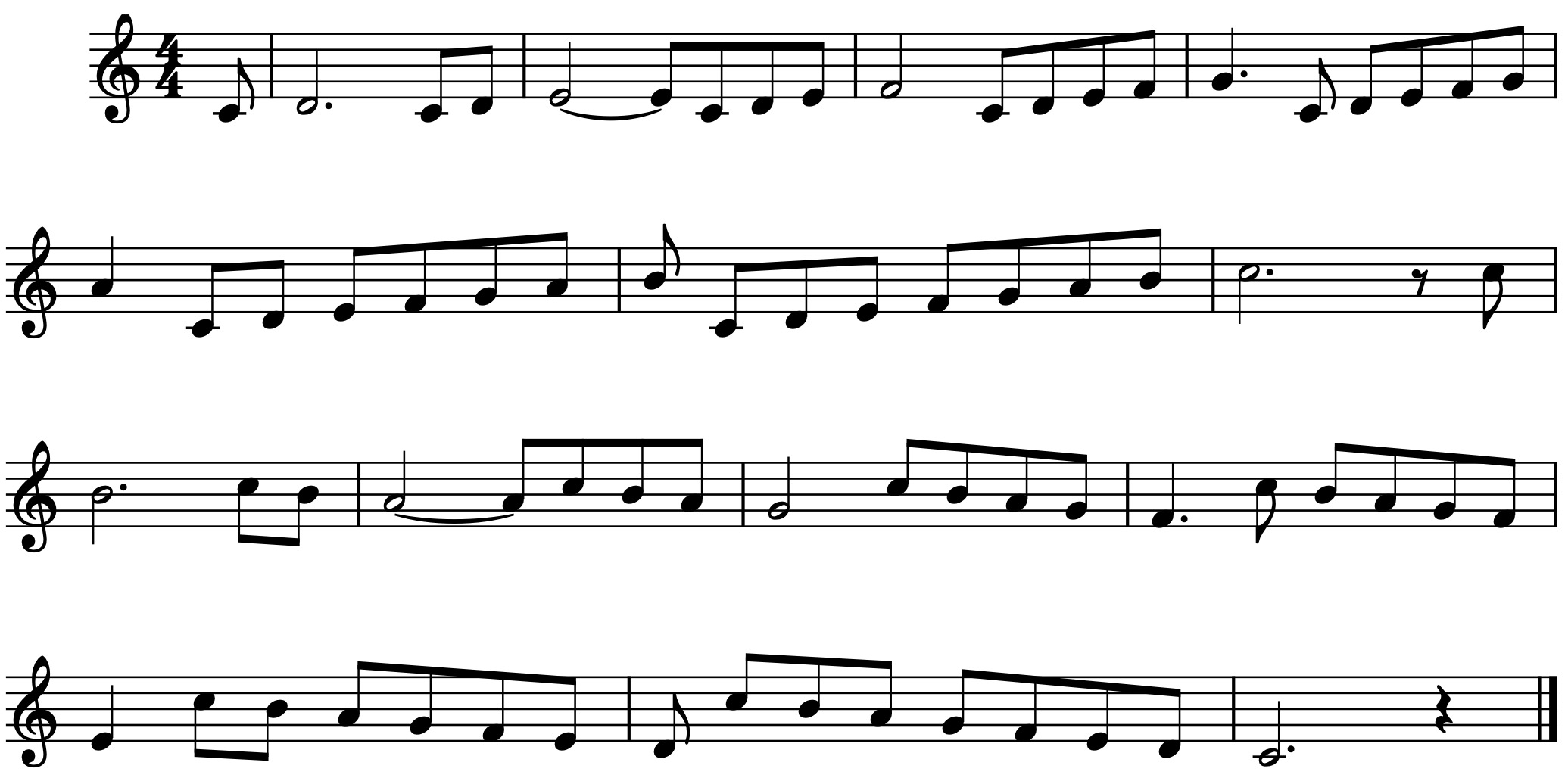
Clap anacruses; clap cruses to passersby. Establishthe systemization3 (x = crusis in {4/4}) {q | x ee | x e ee | x ee ee | x}
Notate
Step the patterns of the systemization, gesturing to a passerby on the crusis
Call attention to introverted movement (i.e. moving in one’s own space, with peripheral awareness of others, but essentially alone) and extroverted movement (i.e. moving with awareness of others, interacting, moving toward others).
Move again with this in mind.(Introvertedmovement tends to be small and enclosed; extroverted movement is larger, and it causes the body to move toward—and interact with—others.)
Watch each other in half groups, enabling a clear visual sense of introverted and extroverted movement.
“Wayfaring Stranger”
Teacher plays, students step: {e ee} | {htiee} This becomes a follow.
{e ee | e q.} The new note ({q.} ) is a metacrusis (a note or notes falling away from the crusis)
Although the actual measures start at the barline, thevirtual measures of an anacrusic piece start with the anacruses. The form of the virtual measures is abaa.
Hand out score and sing with lyrics. Discuss the meaning of the lyrics.
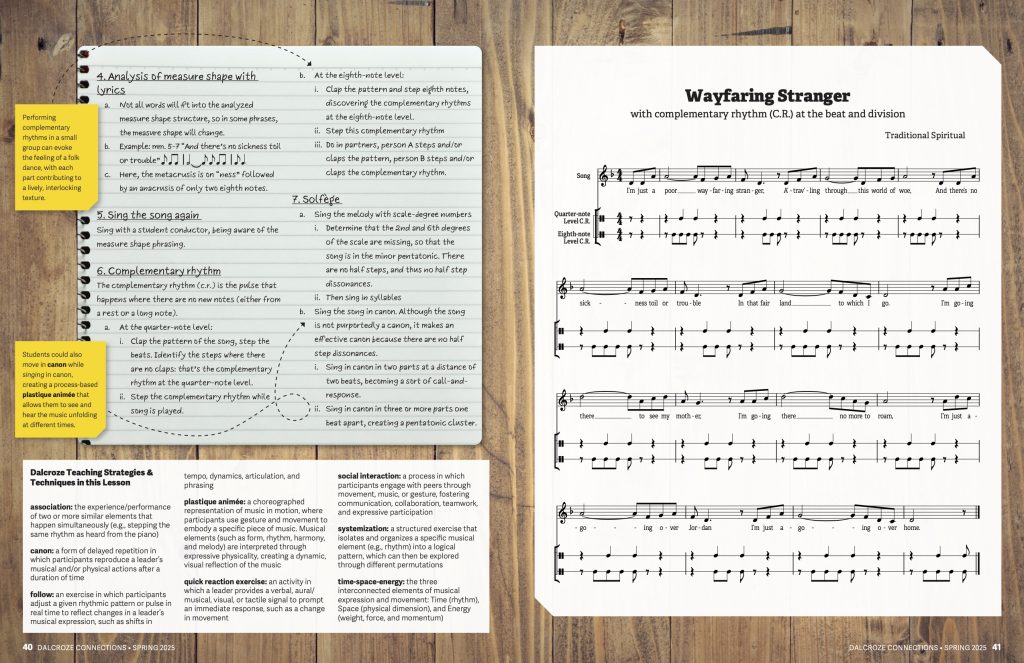
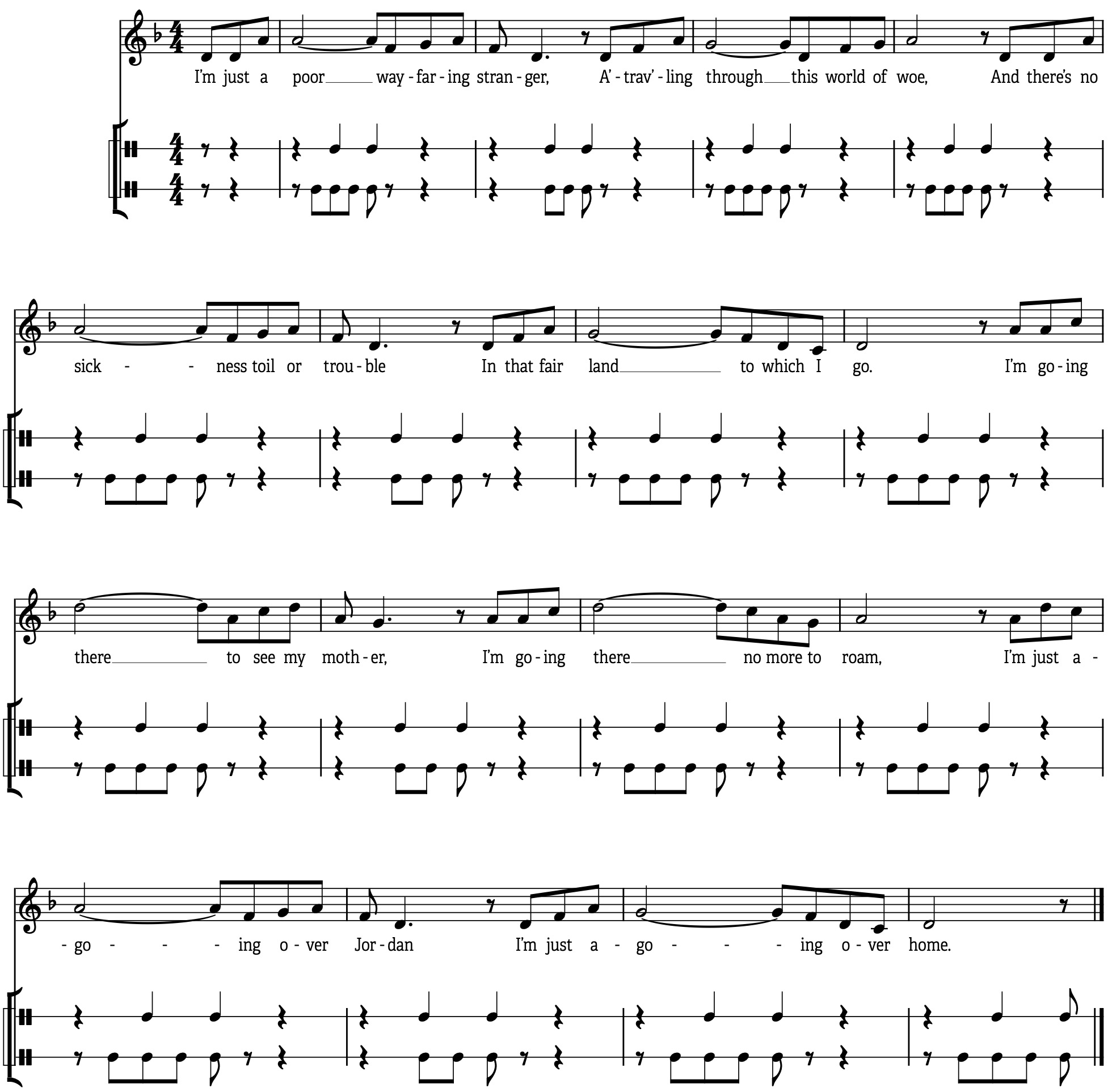
Wayfaring Stranger
with complementary rhythm (C.R.) at the beat and division
Traditional Spiritual
Analysis of measure shape with lyrics
Not all words will fit into the analyzed measure shape structure, so in some phrases, the measure shape will change.
Example: mm. 5-7 “And there’s no sickness toil or trouble”en \hUeen \ej
Here, the metacrusis is on “ness” followed by an anacrusis of only two eighth notes.
Sing the song again
Sing with a student conductor, being aware of the measure shape phrasing.
Complementary rhythm
The complementary rhythm (c.r.) is the pulse that happens where there are no new notes (either from a rest or a long note).
At the quarter-note level:
Clap the pattern of the song, step the beats. Identify the steps where there are no claps: that’s the complementary rhythm at the quarter-note level.
Step the complementary rhythm while song is played.
At the eighth-note level:
Clap the pattern and step eighth notes, discovering the complementary rhythms at the eighth-note level.
Step this complementary rhythm
Do in partners, person A steps and/or claps the pattern, person B steps and/or claps the complementary rhythm.4
Solfège
Sing the melody with scale-degree numbers
Determine that the 2nd and 6th degrees of the scale are missing, so that the song is in the minor pentatonic. There are no half steps, and thus no half step dissonances.
Then sing in syllables
Sing the song in canon.5 Although the song is not purportedly a canon, it makes an effective canon because there are no half step dissonances.
Sing in canon in two parts at a distance of two beats, becoming a sort of call-and-response.
Sing in canon in three or more parts one beat apart, creating a pentatonic cluster.
Anacrusic Systemization
Commentary by Katie Couch
This introduction includes aural reactions (responding to music), tactile reactions (responding to physical sensation), and locomotor gestural movement, where students use previously explored gestures to travel through the space. ↩︎
This is a game that explores time/space/energy while also incorporating social interaction and vocal improvisation. ↩︎
It is important to explore a wide variety of anacrusic rhythms before arranging them into a systemization. ↩︎
Performing complementary rhythms in a small group can evoke the feeling of a folk dance, with each part contributing to a lively, interlocking texture. ↩︎
Students could also move in canon while singing in canon, creating a process-based plastique animée that allows them to see and hear the music unfolding at different times. ↩︎
“When I say change, change between your hands and feet.”
It’s not often that we encounter a eurhythmics lesson without hearing one of these quintessential phrases. They are an integral part of a eurhythmics class and an indicator that students are experiencing one of several frequently used pedagogical strategies: association, dissociation, or quick reaction. Each is a powerful teaching tool for the Dalcroze educator.
Association
when an element (musical or otherwise—a beat, a rhythm, a touch, or a gesture) occurs exactly the same way in two or more voices simultaneously
A teacher plays a pattern and the students clap it; student A draws a line through space and student B mirrors it; a class sings in unison while clapping the rhythm of the song they are singing. These are all examples of association experiences in a class.
Associations provide foundational listening and movement experiences for students; they are building blocks. After teaching college students for over thirty years, I know that students love demanding physical and musical exercises, but I’ve also learned that simplicity matters; associations provide simplicity. I use associations in multiple ways in a class.
To introduce a new topic
When teaching students who are experiencing eurhythmics for the first time, I use association between the piano and their stepping or clapping to introduce the beat in the simplest, most direct way, playing only what students will clap or step. This builds confidence and sets the stage for success while simultaneously teaching students that the piano provides structure and guidance in the class.
I often use the same technique when introducing a new topic; my goal is for students to experience a series of small successes as we gradually build to the big challenge over the course of a lesson.
To set the stage for a more difficult exercise
Imagine your lesson plan or long-term goal includes using a follow in class. My motto is “every good follow begins with a follow.” In a typical follow, students step a rhythm or pattern, and the teacher improvises over it with increasing complexity, using syncopations, hemiola, character changes, and other musical elements. Students need to hang on to the rhythm, stepping accurately and musically throughout the exercise.
I prepare students for successfully executing a follow by playing exactly what the class steps, first in a simple, pure way, gradually adding different dynamics, characters, etc., but still playing only the rhythm. This helps hone their listening skills and adjust to changes in tempo and character without added rhythmic complexity.
To expand a group’s movement vocabulary
Sometimes, students need ideas to spur their movement vocabulary, and I use an association exercise to lead them down a new path. Most often this is as simple as asking students to imitate a gesture I create. (Because the association is with gestures, I refer to this as a physical association rather than an association between a musical element.)
Eventually, I say, “Ok, you’re on your own,” or “Pair with a friend; choose a leader and copy what you see.” I then go back to the piano to improvise as they continue exploring.
Dissociation
when two or more different elements occur simultaneously
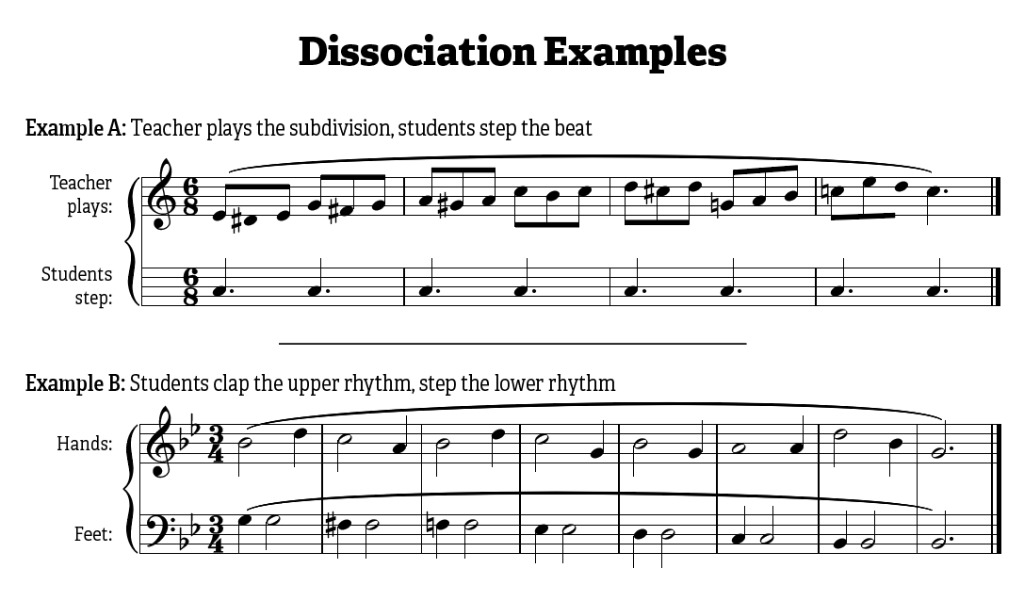
The dissociation may occur between what I play and what students step (I play divisions, they step the beat, or I play triplets, they step divisions), between their hands and feet (they step the beat while clapping the multiple), or between a gesture they see and how they move (their partner’s arms may gesture overhead while theirs move out to the side). A dissociation raises the level of difficulty of an exercise, requiring more concentration and coordination from participants.
Experiences in dissociation encourage physical and aural awareness and are essential to high-level music making. We live in a complex, polyphonic world, and musicians need to develop the ability to perform their part while actively listening to the music happening around them. Jaques-Dalcroze offers this perspective in Rhythm, Music and Education:
One can imagine counterpoints of all kinds. The interesting and useful thing is to experience—live—them organically. Polyrhythm is facilitated by the cultivation of automatisms. An arm will execute a rhythm automatically while the mind executes the execution of a second rhythm by another limb.
Just as with association, I use dissociation exercises to teach a specific skill (e.g., beat/division/multiple) and also as a starting point for more complex exercises, like a quick reaction, canon, or follow. When using this strategy in class, it’s paramount for teachers to recognize that they have the power to either set students up for success or utterly overwhelm them. I work hard to ensure my students have enough experience with each element of the dissociation before I ask to combine them.
For example, we’ll clap and step the beat, then clap and step divisions; once this is comfortable (becoming an automatism), I may add a layer and ask students to clap the divisions while I play the beat, then switch between the two. Some classes need an additional step of pairing students, with each partner performing one of the rhythms (giving the added benefit of social interaction). Once they master each step—which may take three minutes or thirty, depending on the group—they perform the dissociation independently. Typically, I start with the more “solid” (most often slower) element in the feet and the quicker in the hands before asking the students to change.
Dissociation exercises turn from moments of challenge to moments of pure joy in a eurhythmics class, particularly when students are asked to perform complex dissociations. I remember well the first time I was asked to step amphibrach (a syncopated rhythm pattern) tempo primo in my feet and twice as fast in my hands. Despite careful preparation by my teacher, it seemed impossible! Eventually, as I mastered the skill, the sense of accomplishment and joy I experienced was palpable. I’ve watched the same transformation in my students over the years; I think it’s one of the secret rewards of our work.
Reassociation & Automatism
when a dissociation becomes easy—an exercise we can execute without effort or thought—it is a reassociation
A reassociation creates freedom and enhances the spirit of play for students of any age and level. It becomes, in fact, an automatism, something we can execute completely without thinking, often while focusing on or simultaneously performing something else. Simply put, automatisms are the Dalcrozian’s answer to multitasking. Automatisms allow us to shift our focus from one task to something new or more difficult and to trust our physical capabilities.
Do I use automatisms in class in the same way I use other strategies? No. Mostly, they are something I observe, a sign I can challenge students with a more difficult exercise. But I can’t imagine executing many other exercises—a dissociation, ostinato, canon, polyrhythm—without the benefit of an automatisms.
Jaques-Dalcroze understood the vital role automatisms play in our daily lives. In Rhythm, Music and Education, he wrote, “The better our lives are regulated, the freer we become in every way. The more words are included in our vocabulary, the more our thought is enriched. The more automatism possessed by our body, the more our soul will rise above material things.”
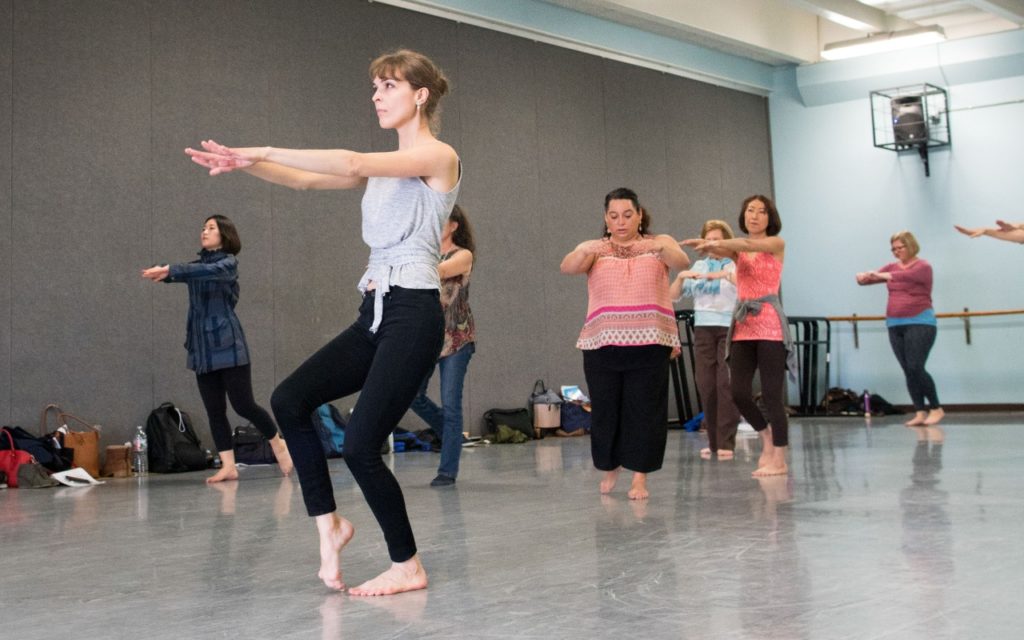
Eurhythmics students work to automatize the Dalcroze arm beats in 5. Photo by Kathryn Nockles.
Quick Reaction Exercises
If there is a classic exercise in the eurhythmics experience, the quick reaction may be it.
I remember my first eurhythmics class when my teacher said, “And when I say ‘change,’ you’ll change between hands and feet.” My eyes got big and I thought, “You want me to do what?” I never thought this was a skill I could master, and certainly, in that moment, I never realized how much fun quick reaction exercises could be. Musicians need to be flexible, ready for change, and prepared for the unpredictability of performance. Quick reaction exercises serve to develop these skills while allowing teachers to reinforce new concepts and build the level of challenge in a class.
In a quick reaction exercise, the teacher uses a signal to motivate a change in movement through one of four means: verbal, aural/musical, visual, or tactile. Each challenges students differently and develops other skills, such as listening, coordination, and concentration, in various ways.
Verbal Quick Reaction
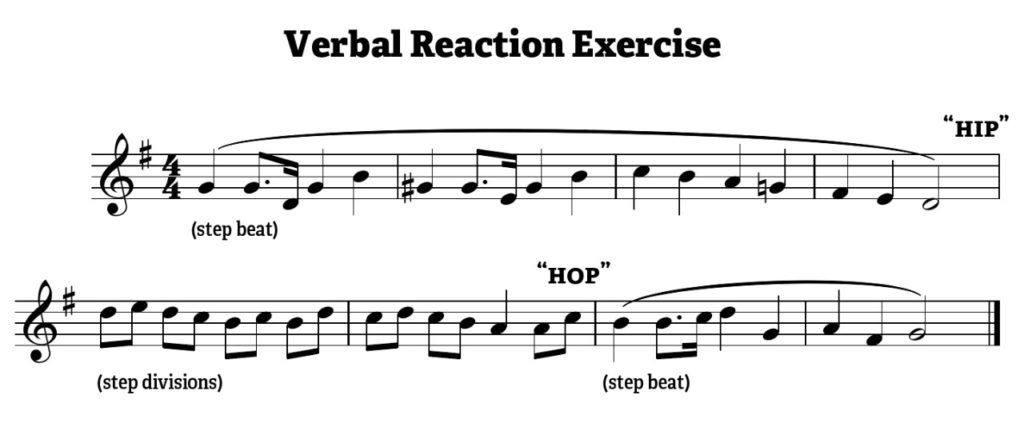
Here, the teacher (or a student) gives a verbal cue (“change,” “hip,” “hop,” etc.) to stimulate change. The frequency of the signal is one component that determines the level of difficulty of the exercise. When I’m introducing a topic, I may signal change at the end of a phrase; as students master the skill, I increase the frequency to add a layer of difficulty.
One of my favorite things to do in a class is to choose an interval (each measure, for example) to say “change,” to set up a habit, then change the interval at which I give the signal. Invariably, students have been lulled into believing the pattern will last forever and get surprised by the sudden lack of change! It’s always a great reminder for them of how musicians can’t stop listening, thinking, and reacting. Unpredictability is fun.
Aural/Musical Quick Reaction
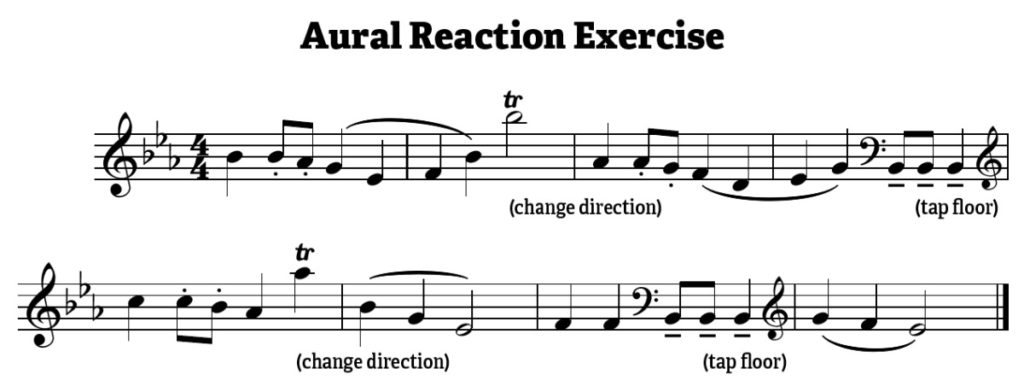
Laced into the teacher’s improvisation, an aural quick reaction uses music to signal a change. An easy example of an aural reaction is playing for a locomotor skill—a march—then changing to another—a skip—using only the music as a guide. No words!
The possibilities are endless: Music in major may indicate stepping forward; in minor, backward. Three notes played in the bass might indicate tapping the floor; a trill in the soprano means turn around or change direction. Aural reactions are fun and help develop listening skills.
Visual Quick Reaction
Here, students need to watch the teacher (or a partner) to execute a change.
The teacher might tap beats on their head, and students imitate. Then the teacher switches to shoulders, then knees, and students make each change with them.
A more challenging visual reaction might use gestures to indicate specific rhythm patterns. For example, in compound meter, arms overhead indicate divisions; arms extended down, the beat; out to the side, a skip; and in toward the chest, short-long. The class claps or sings the rhythm as the teacher moves between patterns; a student could lead the exercise while the teacher plays, leading to interesting experiences with phrasing and cadences. To add another layer, split the class in half. One group watches the right arm; the other, the left, and magically, the quick reaction also becomes a dissociation exercise.
Visual reactions can be helpful to change the pace of a class, or to use when the teacher feels a need to be with the group physically rather than at the piano. They provide opportunities for students to lead an exercise. They also help students learn to “hear” music in their heads when it’s not being provided for them, enhancing their musical imagination and providing a pathway to improvisation.
Tactile Quick Reaction
Here, the signal for change is indicated by touch. This may be the least frequently used type of reaction, but, like an aural/musical cue, is an effective way for teachers and students to communicate without words.
Imagine students seated in a circle. One person walks around the outside of the circle. If they tap someone’s head, that person claps the beat; shoulders, divisions.
Another possibility: in pairs, one student taps beats (or a pattern) on the shoulder of their partner, who responds by clapping, articulating, or improvising a melody in rhythm.
A fun exercise is to place students in a line. The student in the back taps a rhythm on the person in front of them, who does the same to the person in front of them; when the teacher says “change,” everyone turns around and the rhythm “changes” direction. Warning: silliness can easily ensue!
Placing the signal to change is essential to successful execution of any quick reaction exercise. Give the cue too soon and students may try to change before it makes musical sense; too late, and the teacher sets the class up for failure. When I execute a quick reaction in class, I think anacrusically so that placement of my signal aligns rhythmically with the musical element.
Closing Thoughts
Association/dissociation and quick reaction exercises are closely related: an association may quickly turn to a dissociation as the teacher starts to improvise over a rhythm and layers a new skill; that dissociation may then become the basis for a quick reaction exercise. These strategies teach listening, coordination, concentration, and memory and are a valuable asset in a eurhythmics teacher’s cache.
References
Émile Jaques-Dalcroze, Rhythm, Music and Education, trans. Harold Rubenstein (Ashford, Kent: The Dalcroze Society, 1967), 70.
This activity uses the first four notes of the scale, beginning on the tonic. I typically introduce this at the start of class, where I tend to focus on solfège.
Students sit in a circle. One at a time, each student becomes the leader and improvises a short scale-based melody using rhythmic units they’ve previously worked on in eurhythmics.
In simple meter, the rhythmic units may include:
{q} Quarter notes (“beat”)
{ee} Paired eighth notes (“2-8”)
{ssss} Four sixteenth notes (“boomachicka”)
In compound meter, the units may include:
{q.} Dotted quarter (“beat”)
{eee} Three eighths (“running and”)
{qe} Quarter–eighth pattern (“skip and”)
Each unit has a rhythmic word associated with it, which students vocalize while singing. The leader sings a rhythm using these words and moves up the first four notes of the scale, one rhythm per note, filling each beat accordingly.
The rest of the class then sings the pattern in reverse, moving down the scale using the same rhythmic structure. For a more advanced version, the group can begin on the 5th scale degree (^5) and descend to the 2nd (^2). Everyone then sings the tonic on a sustained pitch using a long-note word like “long,” “whole,” or “half.”
an activity in which a leader provides a verbal, aural/musical, visual, or tactile signal to prompt an immediate response, such as a change in movement
The teacher plays a drum and a triangle (or any kind of other hand percussion)
ONE drum sound = step forward
TWO drum sounds = step back wards
THREE drum sounds = stop
ONE triangle sound = leap forward
TWO triangle sounds = leap backwards (this may need some practice)
THREE triangle sounds = stop
Activity
The teacher sings short phrases with music going up or down stepwise. Teacher uses one hand (or both) to show imaginary steps in the space. Students echo.
Teacher does the same with skips (a third or more)
Exploring the piano/glockenspiel/xylophone:
Music going up or down stepwise
Music going up or down, skipping keys
Students take turns exploring
In space:
Piano plays music going up or down stepwise, students step forward or backwards
Piano plays music skipping up or down, students leap backwards or forwards
Conclude by singing a song in which one or more of these are elements of melodic direction are represented.
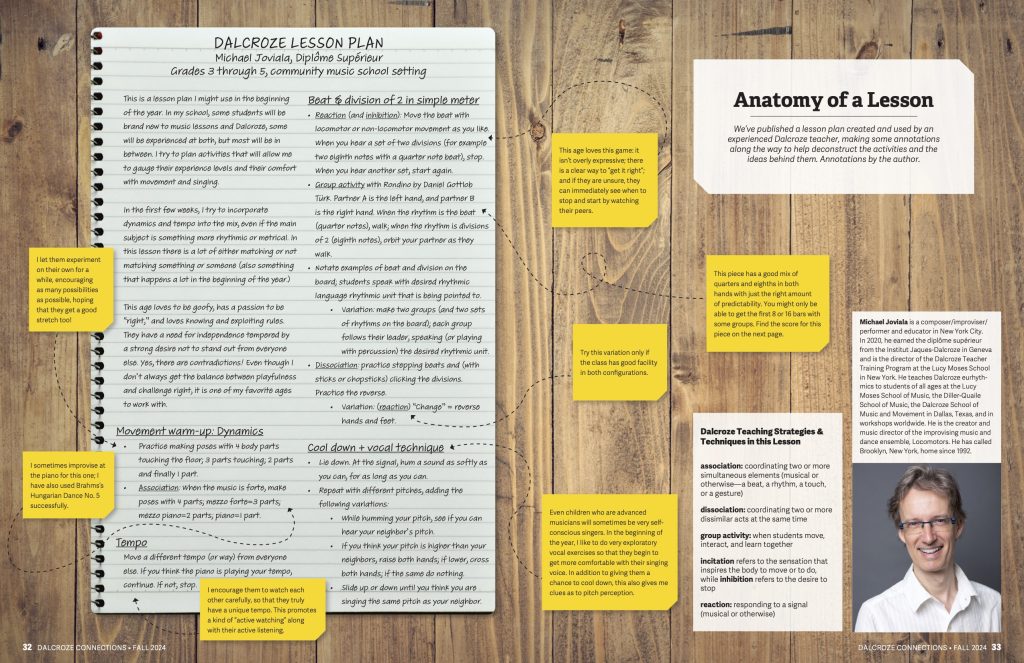
This is a lesson plan I might use in the beginning of the year. In my school, some students will be brand new to music lessons and Dalcroze, some will be experienced at both, but most will be in between. I try to plan activities that will allow me to gauge their experience levels and their comfort with movement and singing.
In the first few weeks, I try to incorporate dynamics and tempo into the mix, even if the main subject is something more rhythmic or metrical. In this lesson there is a lot of either matching or not matching something or someone (also something that happens a lot in the beginning of the year.)
This age loves to be goofy, has a passion to be “right,” and loves knowing and exploiting rules. They have a need for independence tempered by a strong desire not to stand out from everyone else. Yes, there are contradictions! Even though I don’t always get the balance between playfulness and challenge right, it is one of my favorite ages to work with.
Lesson Plan
Movement warm-up: Dynamics
Practice making poses with 4 body parts touching the floor; 3 parts touching; 2 parts and finally 1 part.1
Association: When the music is {f}, make poses with 4 parts; {mf} = 3 parts; {mp} =2 parts; {p} =1 part.2
Tempo
Move a different tempo (or way) from everyone else. If you think the piano is playing your tempo, continue. If not, stop.3
Beat & division of 2 in simple meter
Reaction (and inhibition): Move the beat with locomotor or non-locomotor movement as you like. When you hear a set of two divisions (for example {ee} with a {q} beat), stop. When you hear another set, start again.4
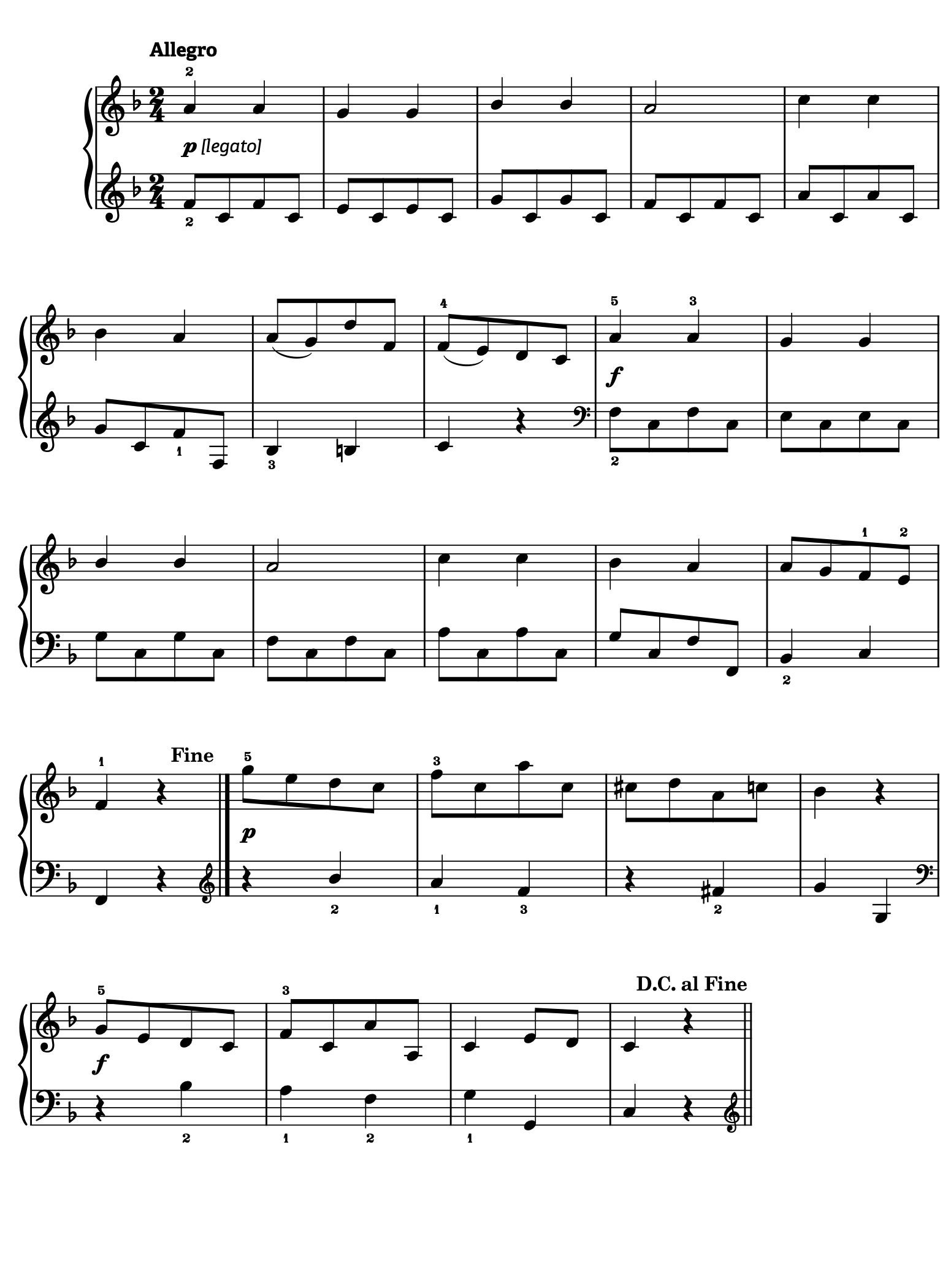
Group activity with Rondino by Daniel Gottlob Türk5. Partner A is the left hand, and partner B is the right hand. When the rhythm is the beat ({q}), walk; when the rhythm is divisions of 2 ({ee}), orbit your partner as they walk.
Notate examples of beat and division on the board; students speak with desired rhythmic language rhythmic unit that is being pointed to.
Variation: make two groups (and two sets of rhythms on the board); each group follows their leader, speaking (or playing with percussion) the desired rhythmic unit.
Dissociation: practice stepping beats and (with sticks or chopsticks) clicking the divisions. Practice the reverse.
Variation: (reaction) “Change” = reverse hands and feet.6
Lie down. At the signal, hum a sound as softly as you can, for as long as you can. Repeat with different pitches, adding the following variations:
While humming your pitch, see if you can hear your neighbor’s pitch.
If you think your pitch is higher than your neighbors, raise both hands; if lower, cross both hands; if the same do nothing.
Slide up or down until you think you are singing the same pitch as your neighbor.
Rondino
Group Activity Example
Daniel Gottlob Türk (1750–1813)
Commentary
I let them experiment on their own for a while, encouraging as many possibilities as possible, hoping that they get a good stretch too! ↩︎
I sometimes improvise at the piano for this one; I have also used Brahms’s Hungarian Dance No. 5 successfully. ↩︎
I encourage them to watch each other carefully, so that they truly have a unique tempo. This promotes a kind of “active watching” along with their active listening. ↩︎
This age loves this game: it isn’t overly expressive; there is a clear way to “get it right”; and if they are unsure, they can immediately see when to stop and start by watching their peers. ↩︎
This piece has a good mix of quarters and eighths in both hands with just the right amount of predictability. You might only be able to get the first 8 or 16 bars with some groups. ↩︎
Try this variation only if the class has good facility in both configurations. ↩︎
Even children who are advanced musicians will sometimes be very self-conscious singers. In the beginning of the year, I like to do very exploratory vocal exercises so that they begin to get more comfortable with their singing voice. In addition to giving them a chance to cool down, this also gives me clues as to pitch perception. ↩︎
In this Dalcroze Eurhythmics quick reaction game students learn to internalize tempo quickly when they are asked to jump so that they land on the fourth note that is played. It is being taught by Dr. Gregory Ristow, a Dalcroze teacher who is assistant professor of music and director of choral activities at DePauw University.
The paintings visible in the background are Billow and Five Dogwoods by artist Nancy Blum, on display in the Colorado State University Art Museum. (The DSA offers its thanks to the museum staff.)